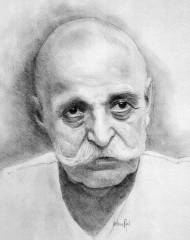
Mr. Gurdjieff was an extraordinary man, a master in the truest sense. His teachings speak to our most essential questions: Who am I? Why am I here? What is the purpose of life, and of human life in particular? As a young man, Gurdjieff relentlessly pursued these questions and became convinced that practical answers lay within ancient traditions. Through many years of searching and practice he discovered answers and then set about putting what he had learned into a form understandable to the Western world. Gurdjieff maintained that, owing to the abnormal conditions of modern life, we no longer function in a harmonious way. He taught that in order to become harmonious, we must develop new faculties — or actualize latent potentialities — through “work on oneself.” He presented his teachings and ideas in three forms: writings, music, and movements which correspond to our intellect, emotions, and physical body.
If they are far down, it is because you are high up.
A ”sin” is something which is not necessary.
The most difficult thing to endure is the manifestations of others.
Laughter relieves us of superfluous energy, which, if it remained unused, might become negative, that is, poison. Laughter is the antidote.
Religion is doing; a man does not merely think his religion or feel it, he lives his religion as much as he is able, otherwise it is not religion but fantasy or philosophy.
Ashes come from burning.
Every stick has two ends.
A man is never the same for long. He is continually changing. He seldom remains the same even for half an hour.
No salt, no sugar.
Conscious faith is freedom. Emotional faith is slavery. Mechanical faith is foolishness.
A man can only attain knowledge with the help of those who possess it. This must be understood from the very beginning. One must learn from him who knows.